
Scoliosis Degrees: What Is the Cobb Angle?
· Scoliosis & Schroth Therapy
Scoliosis is a three-dimensional spinal curvature that can appear particularly in childhood and adolescence and requires regular follow-up. One of the things families most want to understand is how the degree of the curvature is determined. The most widely used measurement here is the Cobb angle. This content is for informational purposes; scoliosis assessment is carried out in collaboration between a physician and a physiotherapist.
What is the Cobb angle?
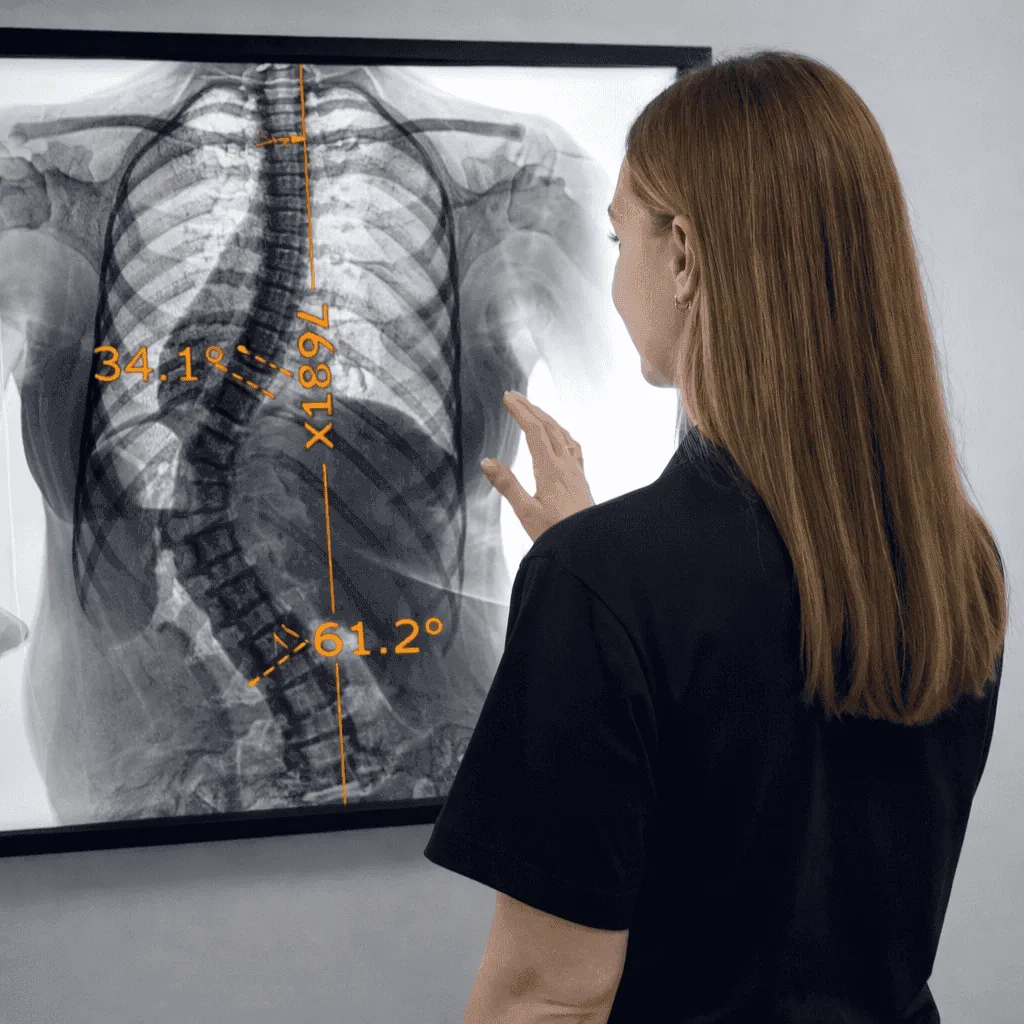
The Cobb angle is a radiological measurement method, accepted worldwide, used to measure the degree of curvature in the spine. It is used to evaluate the presence of scoliosis, the degree of the curvature and whether it is progressing over time. The Cobb angle is measured on an X-ray image and is expressed in degrees (°).
How is the Cobb angle measured?
The measurement follows these steps: the uppermost and lowermost vertebrae of the curve are identified, imaginary lines are drawn from the surfaces of these vertebrae, and the angle at which these lines intersect is calculated. The resulting angle indicates the degree of the curvature.
Important: Measuring the Cobb angle requires experience. Small variations can occur between different measurements on the same X-ray, which is why it is important that follow-up continues under the same conditions and with the same method.
What do scoliosis degrees mean?
Based on the Cobb angle, scoliosis is generally classified as follows:
- 0–10 degrees: Generally not considered scoliosis; posture-related changes may fall into this group. See our article Is my child’s poor posture a sign of scoliosis?
- 10–20 degrees (mild): Monitoring is usually recommended; regular check-ups matter in growing children. An individualised Schroth exercise programme can be planned.
- 20–40 degrees (moderate): Regular follow-up is required. In children whose growth plates are still open, bracing may come onto the agenda alongside a physician’s evaluation. For details, see our article on bracing in scoliosis.
- 40 degrees and above (advanced): Multidisciplinary evaluation is required; collaboration between the orthopaedic physician and the physiotherapist is important. Not every high degree requires surgery; the decision is made by weighing many factors together.
Is the Cobb angle enough on its own?
No. Although the Cobb angle is an important measurement, it is not sufficient on its own. Assessment also takes into account age, growth rate, the location and type of the curve, posture analysis and muscle strength. This is why scoliosis is evaluated through a holistic approach, not through a single number.
Does the degree of scoliosis change over time?
The degree of scoliosis can change over time, particularly in growing children. Rapid height gain and hormonal changes can affect the course of the curvature. This is why regular check-ups at set intervals matter for people with a scoliosis diagnosis. We covered the factors that affect progression in detail in our article Why scoliosis progresses in children.
In summary: the degree of scoliosis is a guide
The Cobb angle is a powerful tool for evaluating scoliosis; however, it is not sufficient on its own. The soundest approach combines physician and physiotherapist assessment, regular follow-up and individualised planning. For details on Schroth, one of the scoliosis-specific exercise approaches, see our article What is Schroth therapy?